Skip to content

Bait has been attracting fish into pots and traps for generations.
But as bait costs rise and fishermen look for ways to improve catch efficiency, can light be used to attract catch into fishing gear instead?
Recent studies suggest it can. But not in a simple, one-size-fits-all way.
LED lights have increased catches of northern shrimp in pot trials off the west coast of Scotland. Illuminated pots also show striking results with scallops. Meanwhile, illuminated pots caught fewer Norway lobster and more juvenile poor cod.
What works depends on the species, the pot, the colour and setting of the light, where it is positioned and the conditions around the gear.
So the question is not simply “can LED fishing lights replace bait?”.
Instead, it is: “when, where and how can light change what enters a fishing pot?”
Why add a Light to a Fishing Pot?
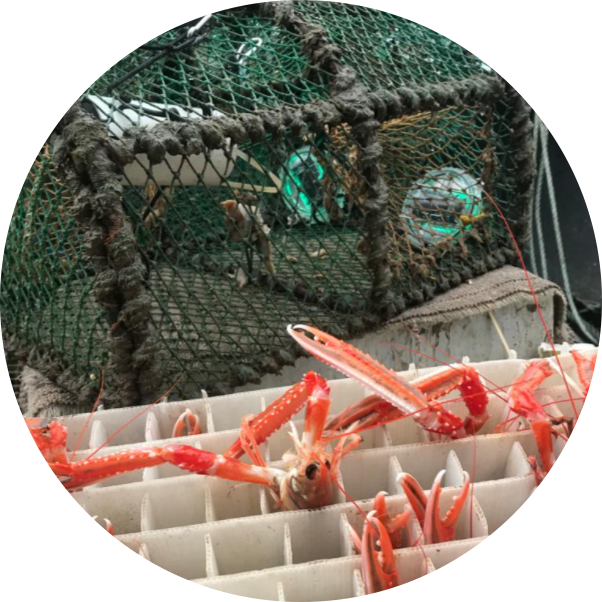
A baited pot gives an animal a reason to approach the gear.
But bait gets eaten, breaks down and its effectiveness can change during a soak.
Artificial light offers another way to influence what happens around the gear.
Instead of providing food, it creates a visual stimulus that can be controlled and repeated.
Animal behaviour underwater is influenced by more than smell. Vision, movement, prey behaviour and environmental conditions can all affect how animals respond to fishing gear.
So, could the right light make a pot more attractive without relying entirely on bait?
Attraction is only part of the story. An animal can approach a pot without entering it, enter without being retained, or respond to a light without producing a higher catch.
“There’s no silver bullet. But if you remove chaos and start working with animal behavior instead of against it, light becomes a very powerful tool.”
Tom Rossiter, CoFounder of CatchCam Technologies
What Does the Research Show?
There is growing evidence that artificial light can change catch rates and animal behaviour around fishing gear. But the results are species-specific and gear-specific.
Northern shrimp and Norway lobster
A 2025 study by the University of Exeter and Fishtek Marine tested white LED lights in pots targeting northern shrimp (Pandalus borealis) off the west coast of Scotland.
In some comparisons, illuminated pots caught up to 19 times more northern shrimp than unlit pots. However, the overall catch volumes were not commercially viable in the trial.
But how? An “attraction cascade” is a possible explanation. The light may attract zooplankton, which in turn attract shrimp that feed on them. Larger predators may then also be drawn towards the pot.
But the same light also changed the catch of other species.
Illuminated pots caught 48% fewer Norway lobster (Nephrops norvegicus), while juvenile poor cod (Trisopterus minutus) catch rates increased by 88%.
So, light may increase target catch, but it can also affect the behaviour of other animals around the gear.
Scallops
Different animals see and respond to their environment differently.
In a study off Cornwall, researchers investigating illuminated crab and lobster pots recorded more than 500 scallops, with 99.6% caught in pots fitted with lights.
In a similar deployment, cameras were also deployed inside the pots to monitor behaviour around the gear.
What About Crab?

Brown crab is another interesting case.
Jasper Van Vlasselaer, a researcher at the Flanders Research Institute for Agriculture, Fisheries and Food (ILVO) , has been using Pisces lights to investigate how commercially important species respond to different light stimuli.
Cuttlefish, spider crab, brown crab, brown shrimp, European lobster and great scallop are all included in his work.
“We’ve used Pisces lights in a range of active gear settings like beam trawl, flyshoot, shrimp and flatfish trawl, to increase selectivity by encouraging certain species or sizes to escape. In trials for passive gear, like in pots, we used the lights as an attractant. They have also been useful for illumination when doing camerawork"
Jasper Van Vlasselaer, researcher at ILVO
And, once again, responses varied considerably.
In pot trials in the German Bight in the North Sea, white light appeared promising for brown crab, while blue light produced the opposite response. Laboratory work with brown shrimp has also found differences between light colours, with a stronger preference for green light.
In these experiments, pots with lights were compared with pots without lights.
The results reinforce the same point: different species can respond differently to different light stimuli.
Testing Light in Commercial Pot Fisheries


Stefan Tijsen, from the Pot Fishing Agency, deploying pots equipped with Pisces underwater LED fishing lights during trials in the Netherlands.
One of the limitations of conventional bait is that its effectiveness can change during a soak. As Tijsen explains in an article by Jason Holland:
“What we’re seeing with normal bait is that you put it into the pot and after a few days the smell is already gone on the seabed. What we want to do is create systems that attract animals for much longer.”
Stefan Tijsen, director of the Pot Fishing Agency
Stefan Tijsen, director of the Pot Fishing Agency in the Netherlands, is testing Pisces lights alongside other attractants to investigate how different stimuli influence animal behaviour and catch.
That includes developing biodegradable gel-based attractants and timed-release bait systems.
One concept under development uses timed bait release for Dover sole, with attractants released during periods of higher activity. The idea is similar to testing different light settings: control the stimulus, observe the response and find out what works for the species and fishing conditions.
Choosing LED Fishing Lights for Your Gear
Once light is treated as part of the fishing method rather than simply a piece of equipment, some variables become important:
- Colour: white, green and blue provide different stimuli. Red can be used where reducing disturbance is important.
- Flash pattern: continuous light is not equivalent to flashing.
- Position: a light on the roof of a pot can create a different stimulus from one positioned near the entrance.
- Pot design: mesh, entrance size, internal structure can all affect what an approaching animal sees.
- Fishing conditions: depth, water clarity, daylight, seabed habitat and soak time can influence the response.
Pisces provides six colours and four flash rates, allowing fishermen and researchers to test different light stimuli rather than simply comparing “light” with “no light”.
The lights can be deployed on pots and traps as well as trawls and dredges, with around 20 hours of operating time.
In Jasper’s pot trials, Pisces lights were mounted on the roof of the pot, facing downwards or angled towards the entrance.
“The big advantage that I see is the charging method. No fiddling with batteries, which also becomes expensive if you must buy new ones every fortnight. Popping them out straight into a case to charge is handy.”
Jasper Van Vlasselaer, researcher at ILVO

Can LED Fishing Lights Replace Bait?
Not universally.
The research so far shows that artificial light can increase attraction or catch rates for some species and fishing setups. It can also have little effect or increase unwanted catch in some cases.
That makes “bait replacement” too simple a way to think about the technology.
For fishermen, the more useful question may be whether light can reduce the amount of bait needed, improve catch efficiency or make a particular gear and species combination more selective. For researchers, it provides another variable to test alongside pot design, entrance design, bait and soak time.
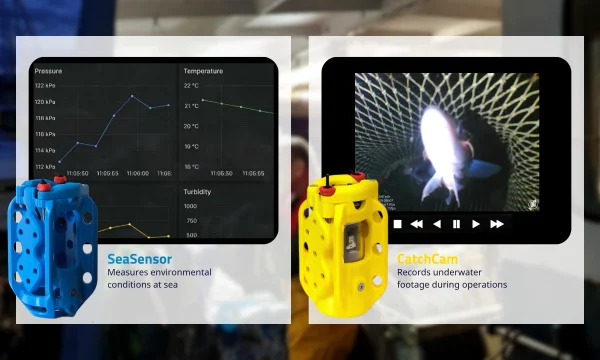
This is also where underwater video can add useful context. Catch data shows the final result, but a camera can show what happens around the gear. So, whether animals approach, enter, avoid the pot or respond to lighting conditions.
“The future of our fisheries is selective low impact fishing gears that are agile and responsive to the available resources. Static gears offer opportunities to do things better, however the catching process is much more nuanced than mobile fishing and we have a lot to learn”
Tom Rossiter, CoFounder of CatchCam Technologies
Testing Light on your Fishing Gear?
Use Pisces LED lights to test how different light settings affect your catch, and CatchCam cameras to see what happens around the gear underwater.
We can help you find out what works for your fishery.
FAQs
Not necessarily. Light and bait work in different ways, and the response depends on the species, gear, colour and light setting, and fishing conditions. Trials show that light can reduce the amount of bait needed or improve catch efficiency, but it should be tested rather than assumed to be a direct replacement.
Some crab species respond to artificial light, but the response depends on the species and light used. Research and field trials with brown crab show promising results, although responses can vary between laboratory and sea conditions.
Yes, in some cases. Trials with northern shrimp and scallops have found an increase in catch or attraction when pots are illuminated. However, light can also affect other species around the gear.
Catch numbers tell you the result, but underwater video shows what happens around the gear. It can help identify approaches, entries, avoidance and changes in behaviour under different lighting conditions.