For six years, parts of California’s spring Dungeness crab fishery remained effectively closed due to whale entanglement risk.
In 2025, something changed.
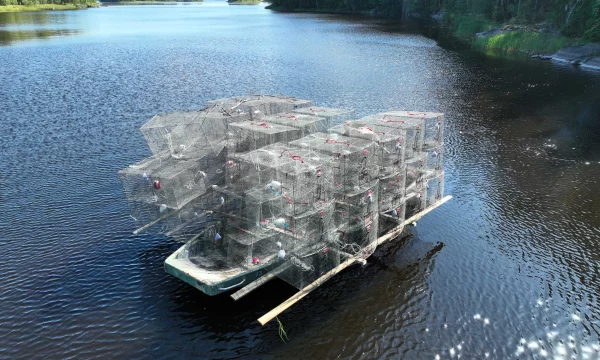
Under a California Experimental Fishing Permit (EFP), more than 25,000 traps were deployed using ropeless “on-demand” systems.
The result?
$1.4 million in landed crab with only 0.2% gear loss rate, according to EFP 2025 project reporting.
Building on that success, ropeless fishing gear is now being tested offshore in American lobster (Homarus americanus) fisheries, where deeper water, stronger currents, and longer groundline strings present new challenges.
What Is Ropeless Fishing Gear
Ropeless, also known as “pop-up” or “on-demand” fishing gear removes the need for vertical lines.
Traditional pot and trap fisheries use surface buoys and vertical lines to mark and retrieve gear.
Instead, ropeless gear keeps the trap, line, and buoy on the seabed until triggered by the fisherman using acoustic or timed-release technology.
This approach significantly reduces whale entanglement risk and gear interactions with maritime traffic and storm activity.
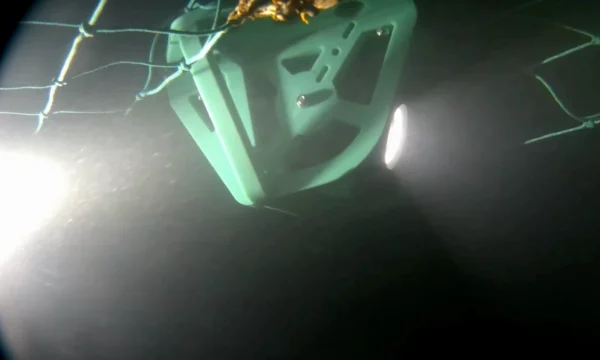
The Ropeless Sled being deployed in offshore lobster fisheries. Video recorded using the CatchCam camera.
During early trials in Oxnard, California , CatchCam worked alongside Sustainable Seas Technologies and Guardian Ropeless to see exactly how these systems deployed. This helped ensure reliability before scaling up offshore.
Taking Ropeless Fishing Offshore
After proving its reliability in coastal crab fisheries, the next challenge is offshore deployment in lobster fisheries.
“We call this unit the Guardian Offshore Sled, which is designed for deeper-water, offshore lobster fisheries.”
Russ Mullins from Guardian Ropeless
The offshore sled is engineered to handle large diameter rope, heavier buoys, and stronger currents, while maintaining consistent acoustic activation. It holds up to 200 fathoms of line, allowing it to function as both a trap anchor and a trawl endpoint.
“This particular test was conducted in about 70 fathoms,” adds Russ.
Here you can see Guardian Offshore Sled in action: it releases the buoy and line to the surface when triggered by the fisherman. This specific deepwater test shown in the video had a current of about 1.5 knots on the surface.
“This is the same CatchCam camera that we had in California when testing our ropeless gear in real world conditions,” adds Russ.
Lessons learned in California directly informed the offshore sled’s design. And CatchCam footage accelerated this process by clearly showing line deployment, buoy ascent, and overall reliability underwater.
Why This Matters for Commercial Fisheries
The expansion of ropeless gear offshore shows how innovative fishing technology can solve both operational and environmental challenges.
While it won’t replace traditional methods across all fisheries, it is now a viable option for reopening previously restricted areas, from California Dungeness crab to offshore lobster fisheries.
As the technology matures, CatchCam and partners like Guardian Ropeless continue to refine deployment, reduce gear loss, and enhance overall fishing efficiency.
For operators interested in testing or adopting ropeless systems, CatchCam provides support to observe, validate, and integrate new ocean technologies into daily operations.
If you’re exploring ropeless systems, reducing bycatch, or simply want to understand how your gear behaves underwater, we’re here to help.