Skip to content

The ocean is a tough place for technology: visibility drops, gear moves constantly, and conditions change by the minute. Still, new AI tools are starting to make a real difference in the places that matter most: finding fish, reducing unwanted catch, improving stock assessments, and giving crews clearer information to work with.
Here’s where AI is genuinely helping, and where the fishing industry is heading next:
‘Where AI can help improve capture underwater’ presented at the Catch Welfare Platform Conference in November 2025.
Why AI in Commercial Fisheries
Every skipper, scientist, and gear developer reading this knows the work is heavy. The industry is making progress, but we’re lagging behind other sectors.
If AI can help:
- spend less time searching
- avoid unwanted catch
- save fuel and reduce costs
- Improve catch quality and welfare
- reduce gear impact
- Make operations safer
- Improve fisheries monitoring and assessment
…then it has value.
But AI in fisheries must be grounded in the day-to-day reality of working at sea. As Tom Rossiter explained in the Catch Welfare presentation above: “We need to pick our battles. Some areas are incredibly difficult, but others are ready right now.”
AI in Fisheries Management: What’s Working Today
Despite challenging conditions, many AI tools are already proven in the field.
Fishing Predictions
AI systems like Fish Square (Japan) and DOLFIN (France) analyse satellite data, ocean conditions, and historical catch patterns to help vessels locate target species faster. These tools are examples of precision fishing with AI, optimising fuel use and improving efficiency. However, adoption costs remain high and its use is currently mostly limited to tuna fisheries.
Seabed Impact
Some vessels now use AI-supported trawl doors that automatically maintain a set spread, even when the skipper alters course. Pelagic fleets have used this for years, and early demersal are appearing. In Canada, Katchi are developing a system for demersal fishing, allowing the net to just fly above the seabed, but not touch it.
Bycatch Detection and Selection
Technologies like Smartrawl by FiS can identify species and sizes inside the net and open or close gates accordingly. Other systems, like the FloMo project, are exploring remotely opening the codend when unwanted species appear in the catch and this will be available in 2026.
The challenge? Trust.
“If you tell a fisherman a box will open the codend automatically, he won’t buy it. But if he watches a video in the wheelhouse, sees a shark or a sea lion he doesn’t want, and presses a button. He’ll soon realise automation can help,” shares Tom Rossiter in the presentation above.
This is where AI becomes meaningful: when it’s guided by the skipper.

Catch Handling and Welfare
Leaving catch in the codend can damage quality. Initiatives like Tide 2030 can pump catch immediately onboard to reduce stress and harm. The Nephrops tailing machine, which just won the Catch Welfare Innovation Award, is another example of AI improving handling efficiency. This tool kills and tails the animals in an efficient and humane manner.
Science and Fisheries Management
Every vessel today generates data – sonar, sensors, cameras, plotters – but most of it is lost. Our team at CatchCam, in partnership with Norwegian company SailorsMate, is integrating multiple data sources into a single view, so skippers don’t need to watch twenty screens at once. Getting the right information in front of fishermen at the right moment is where AI can make the biggest impact in the near term.
Where AI Still Struggles and Why Video Can Help
Some aspects of underwater monitoring still remain beyond AI’s reach. Moving trawls create motion blur, sediment clouds, and shifting light, making automated analysis extremely difficult.
But every improvement in visibility makes AI more accurate. Every extra camera angle makes the data richer. Every additional viewpoint reduces blind spots.
That’s why our focus is simple: give AI the best possible images, from as many points on the gear as possible.
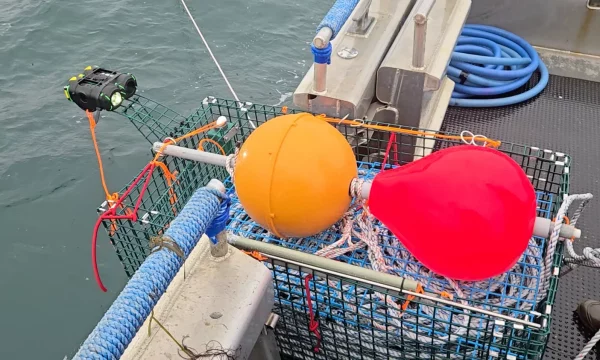
CatchCam’s robust underwater monitoring cameras can be deployed inside the net, along the wings, on the ground gear, at the codend, and anywhere your gear goes. They are engineered for the harshest fishing conditions and deliver the consistent, usable footage AI needs.
Because AI is only as good as the images it sees. Our job is to make those images better, and to make sure you can put a camera exactly where it matters.
The Path to Smart, Sustainable Fisheries
From predicting the best fishing grounds to helping avoid bycatch, from safer crew operations to better catch handling, AI is becoming a practical tool.
But, the industry won’t get there by working in silos. Collaboration is essential.
We need to think beyond next year and imagine what a fishing vessel should look like in 2050, then start building the pieces that get us there.